To collect or invest in Tolkien first editions, buy the earliest printing you can afford in the best possible condition, complete with its original dust jacket, and buy it from a specialist dealer with a reputation to protect. Condition is everything in modern collectable books: the same printing of the same title can be worth £50 or £5,000 depending entirely on its state. There are only a handful of Tolkien titles but hundreds of editions and printings, ranging from £10 to £500,000 or more, something for every budget. Most are easy to identify, prices generally reflect what you get, and if a deal sounds too good to be true, it is.
Collecting Tolkien rare books is a tale of modern, not antiquarian, book collecting. Novice sellers’ and buyers’ mistakes notwithstanding, it is an enjoyable hobby with very few pitfalls. The remote chance of a Tolkien treasure turning up in a grandmother’s attic or a local charity shop barely happens anymore; the public know early editions are valuable and research before parting with them. You do have to teach yourself the basics, which is part of the pleasure. Dealers will help to a degree if you are buying from them, but they are busy and cannot answer every question you could research yourself. I publish guides here, and you can subscribe to our collector’s newsletter at no cost. Where you really need a specialist’s advice is when you are spending thousands on a book.
Why is condition the most important thing in Tolkien books?
The main lesson to learn is that condition is everything in Tolkien books, and in all modern collectable books for that matter. The older the printing, and the closer it is to the first printing, the more valuable it will be. Any printing must, however, be complete with the dust jacket and have no damage beyond normal wear and tear. Generally it has to have been printed by the original publishers and not be a cheap book club edition.
The same book of the same printing can be worth £50 or £5,000; it varies entirely according to condition. There are plenty of worn books; it is the fine ones that are truly rare. Every day someone tells me they have a special old book, and then I learn it is damaged, missing its jacket, or the jacket is severely damaged. Sadly it is then likely to be worthless, while the same book complete and in near-fine condition would be very valuable. As time goes on, even poor copies can rise in value as the best become unaffordable for the collector of average means. Tolkien book collecting caters to all budgets.
How do supply and demand affect Tolkien book prices?
A lesson that has become crucial in the internet age is that you have to assess the supply and demand at any given moment. If there are no other similar copies for sale you will pay a lot more; if there are plenty of copies you will pay much less. This can change month by month, year by year. The long-term trend in Tolkien is steadily upward; I have never seen prices fall. In the last two years, copies published prior to 2000 have been the scarcest, and most are in poor condition.
It pays to shop around and compare dealers if you can, but it is less time-consuming and less risky to buy from a specialist dealer who has a good reputation to protect. General dealers who are not specialists can be inconsistent in both quality and price. Auctions are the worst place to buy: one day you get a bargain, the next you overpay. Auction prices are not indicative of values and trends except over very long periods.
How is the price of a rare Tolkien book actually decided?
When it comes to prices, common sense sometimes goes out of the window. Shopping for collectables on low price alone is as silly as paying too much. You get what you pay for, and the old adage that something is only worth what someone will pay holds true. A rare book, like a house, may be worth £200,000, but you have to find someone who will actually pay it and who believes you when you say it is worth that much. This is where specialists with long-established reputations come in.
If you commission a specialist Tolkien dealer to sell your book, you are paying them for access to their market and relying on their reputation to guarantee quality and support the asking price. People call me all the time asking a book’s retail value, even at the lower end. I might say “roughly £500”, but later they tell me they could not sell it for that, because only a specialist with a good reputation has the credibility to achieve it. If you buy from a specialist you will generally get what you pay for, though not necessarily a bargain, and if there is a problem later you have recourse with a professional. Anything of real value at a bargain price is a near-impossible find, but you can get lucky. If you find a good one, buy it while you can.
Is collecting Tolkien books an investment or a hobby?
Informed collecting, with the intention of making a gain, is investment. It requires experience and management of risk, not luck or a gamble. If you cannot afford to spend the time or lose the money, do not do it; if you do not have time to educate yourself, buy from a specialist dealer. Yes, there is always a speculative element to investing, but rarely do items of true intrinsic value lose their value completely, unless they sit in a highly specialised field like art or are subject to speculators manipulating the market.
Tolkien books are great literature and have lasted the test of time as each new generation discovers his work, something that cannot be said for many authors, who tend to be generational favourites. The best thing you can get from collecting is enjoyment of something you can develop a passion for. Do not choose something just because it makes money, but because it interests you. That way, in the worst case, you can still enjoy the books even if they do not make a fortune.
What are impressions, and how do I read a Tolkien book’s printing?
Impressions are the same as printings, terms derived from the old technology of printing presses making an impression on paper. Everything is now digital, and modern first-printing books traditionally carry a “1” in the number line to denote the first edition. This has changed in the last decade, with books printed in one country and assembled in another, so there are now big variations between publishers as to what constitutes a first printing. First editions, however, are a different thing, determined by the first publisher and country of origin.
Older books show the edition by year and by printing. A first edition, first printing is referred to as a 1st/1st; the next printing is a 1st/2nd, and so on. American publishers adopted the number-line system before their UK counterparts.
Why are ISBN numbers useless for Tolkien collectors?
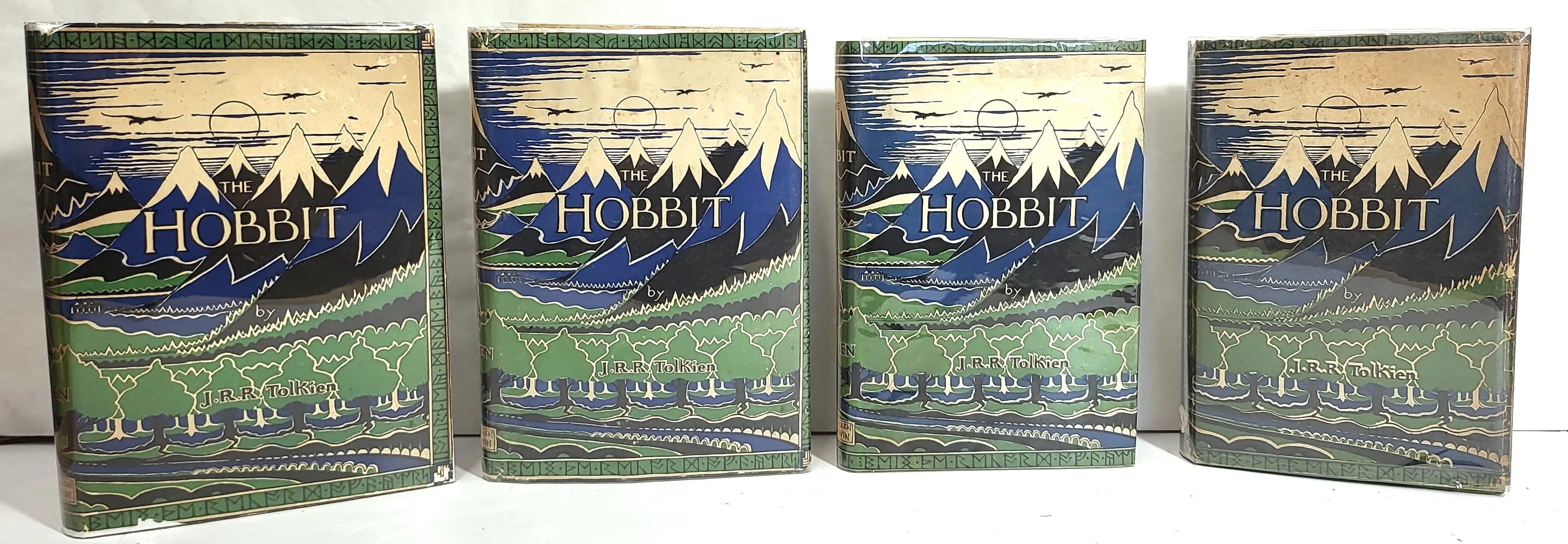
An important note about ISBN numbers: they are useless to book collectors. The number applies to the original registration of that particular publication, not necessarily the first edition of that book, and the same ISBN may be reused for variations like deluxe editions or changes of cover art or artist. For example, there are many variations of the 1966 Hobbit that use the same ISBN. Publishers also created slip-cased sets, as they did with the first Lord of the Rings sets, in which different impressions and ISBNs can be mixed together in a new case.
What is a Lord of the Rings “set”, and why is dust-jacket wear so important?
The original three Lord of the Rings books were printed separately, and as stocks ran out more were printed. Both books and dust jackets can be of mismatched impressions, and jackets were commonly re-used, as paper and the printing process were expensive, so spare dust jackets were not wasted. There are some surviving printers’ records from the mid-1950s, but no distribution records from the publisher Allen & Unwin. A Lord of the Rings “set” was simply whichever three titles happened to be together in a given bookstore, not necessarily matched in year or printing. It was never possible to buy a set of first-edition, first-printings: by the time the first Return of the King appeared, the first Fellowship of the Ring had sold out.
Today, collectors want the earliest impressions of each title that could potentially have been available together, with jackets that match the books’ impressions and similar aging and wear. Serious collectors will pay much more for a uniformly aged set. I coined the phrase uniform wear to mean all three jackets and books sharing similar colour, aging signs and paper wear, so they present well as a set on a shelf, not that they were bought together, but that they were kept together long enough to age uniformly.
Because hardbacks were expensive, publishers used cheaper paper. Most dust-jacket wear is on the spine, which was exposed to the air. With less central heating in Britain then, common dampness led to mould that discoloured jacket paper, especially the spine, ranging from deep brown to white spotting to faded title colours. Damp also caused bleed from the red cloth covers onto the back of the jackets and weakened the paper, leaving spines prone to fraying and loss. The rest of a jacket can still be very nice; the original colour, though, is grey, not beige or white, as you can tell from the grey flaps where the price and reviews appear. The rarest sets I have ever sold had light-grey dust jackets, which by the second edition were dark grey.
Completeness of the jackets is critical to value. Think in terms of percentage of paper loss, say 5% or 10%, usually at the spine ends from being pulled off a shelf. Whole missing sections reduce value significantly. Beware digitally printed facsimile jackets sold cheaply: they add no value whatsoever compared with a set lacking its jackets, and using one to overprice a jacket-less book is not just deception, it is theft.
Do misprints, states and issue points matter?
The 1955 first-edition, first-printing Return of the King has three variations caused by a print error. These are interesting but have no impact on value, and they are not “states” or “issues” at all, just errors. States, points and issues are variations, mostly intentional, and for some antiquarian books without copyright pages they can help identify true first printings. But for modern books like Tolkien’s, first editions are clearly stated and easily identified by the number line, so variations are of interest to some buyers, and to sellers trying to inflate values.
Collecting more than one first-edition variation of The Return of the King is a waste of money. Condition matters most, not misprints, states and issues. There is a certain type of collector who attaches great significance to variations where none exists; avoid dealers who do the same, as it usually means they are overcharging you.
All copyright 2024–26, Festival Art and Books & Mark D. Faith.