Both books are masterpieces, but which is the best?
I am asked this constantly, and collectors often mean something quite different from what literary critics argue about. They want to know where to put their money, what to hunt for first, and which title will still matter in twenty years. After twenty-five years dealing in Tolkien first editions, my answer is blunt: you need both, but they play different roles in a collection, and the market treats them differently.
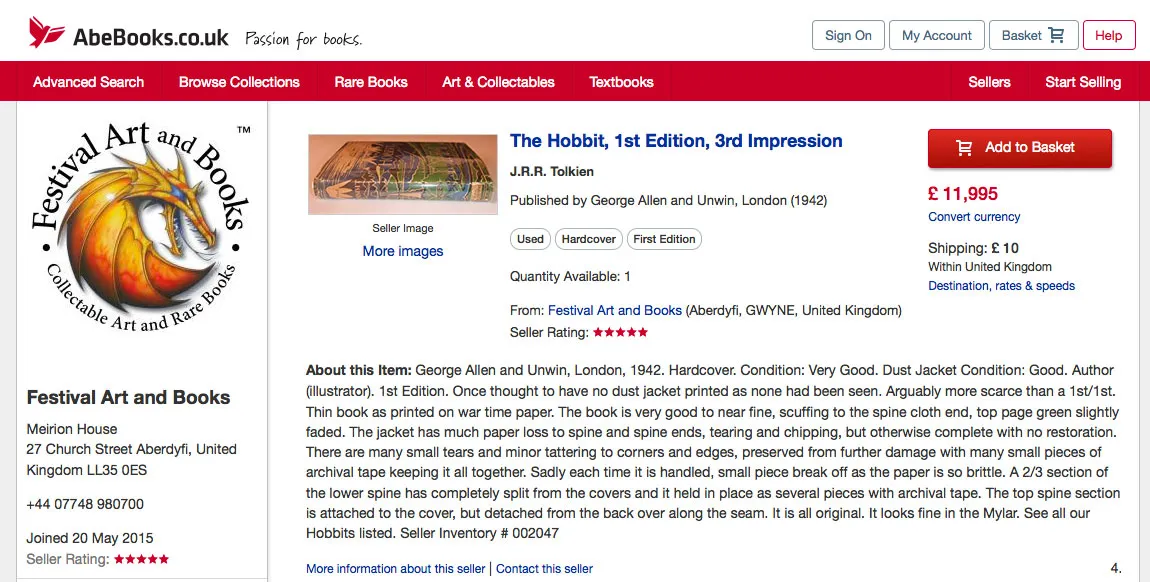
The Hobbit is where almost everyone starts, and for good collecting reasons, not just nostalgia. Published in 1937, it is a single volume, comparatively approachable in price at the lower end of first-edition collecting, and instantly recognisable. That green dust jacket with Tolkien’s own illustrations is one of the great icons of twentieth-century publishing. But here is what novices underestimate: The Hobbit suffers the worst attrition of any Tolkien title. It was marketed as a children’s book. Copies were read to pieces, jackets were lost, and damp British housing destroyed more Hobbits than any other factor. Of the thousands Allen & Unwin printed in the 1930s and 1940s, only hundreds survive in anything like collectable condition. When a fine first edition appears, complete jacket, no restoration, honest wear only, it commands serious money, and deservedly so. I have sold signed Hobbits for figures that still make general booksellers blink.
The Lord of the Rings is another matter entirely. Three volumes, three jackets, three opportunities for something to go wrong. A purported 1950s set with mismatched impressions and uneven jacket ageing is a compiled set, not a time capsule. The collector who understands this looks for uniform wear across all three volumes, the only reliable clue that a set has lived together since publication. First-edition LOTR sets in fine condition are the summit of Tolkien collecting. I have handled sets that sold for £75,000 in an earlier market; on television I declined offers for a set I knew was worth holding. Prices move, but the principle does not: a complete, matched, honestly described three-volume first is the centrepiece around which a serious collection is built.
So which is “best”? If you are building a collection from scratch, buy The Hobbit first, earliest printing, best condition, complete jacket. It is the foundation. Then work toward LOTR, volume by volume if you must, but never compromise on jacket condition to save money. A cheap, worn set will not appreciate; I have seen collectors learn that lesson expensively.
Both titles are the core of any Tolkien collection. Everything else, Farmer Giles, Tom Bombadil, the History of Middle-earth, orbits these two. Literary merit is not the question collectors are really asking. They want to know what endures in the market. On that score, Professor Tolkien gave us two indispensable books, and a dealer who tells you to choose only one is not giving you honest advice.